Even more knowledge

Mini‑dental implants are narrow‑diameter titanium screws (typically 1.8‑3.3 mm wide and 10‑15 mm long) that can be placed in a single visit under local anesthesia, often without stitches or bone grafts. Their small size allows them to fit in narrow inter‑tooth spaces and in alveolar ridges that lack the width needed for conventional implants, making them an excellent option for patients with limited jawbone volume. When bone is thin or has undergone resorption, traditional implants may require invasive grafting procedures, whereas mini‑implants provide immediate stability for dentures, single crowns, or small bridges while preserving existing bone. At Gentle Dentistry of Staten Island, the team emphasizes patient‑centered care: they conduct thorough CBCT imaging, discuss treatment goals, and tailor a minimally invasive plan that balances functional needs with comfort and cost, ensuring each patient receives a personalized solution for their small‑bone situation.

Mini dental implants are best suited for patients who lack the horizontal bone width or density required for conventional implants, making them ideal for those with mild‑to‑moderate jawbone loss, narrow inter‑tooth spaces, or a history of long‑term denture wear. They also appeal to individuals who want a minimally invasive, single‑visit solution and wish to avoid bone grafting or sinus‑lift procedures. Good overall health, controlled systemic conditions (e.g., diabetes), and non‑smokers are preferred, as smoking and uncontrolled disease increase failure risk. Before treatment, patients should understand that the procedure uses small‑diameter titanium screws (1.8–3.3 mm) placed under local anesthesia, often without stitches, and may allow same‑day provisional restoration. Post‑operative care mirrors natural teeth—twice‑daily brushing with a soft brush, daily flossing, and routine check‑ups are essential to prevent peri‑implantitis. A thorough clinical exam, CBCT or panoramic imaging, and review of medical history will confirm adequate bone volume, cortical thickness, and absence of contraindications such as severe osteoporosis. Financial planning should include the implant cost, possible follow‑up visits, and any required prosthetic components.
Clinical benefits
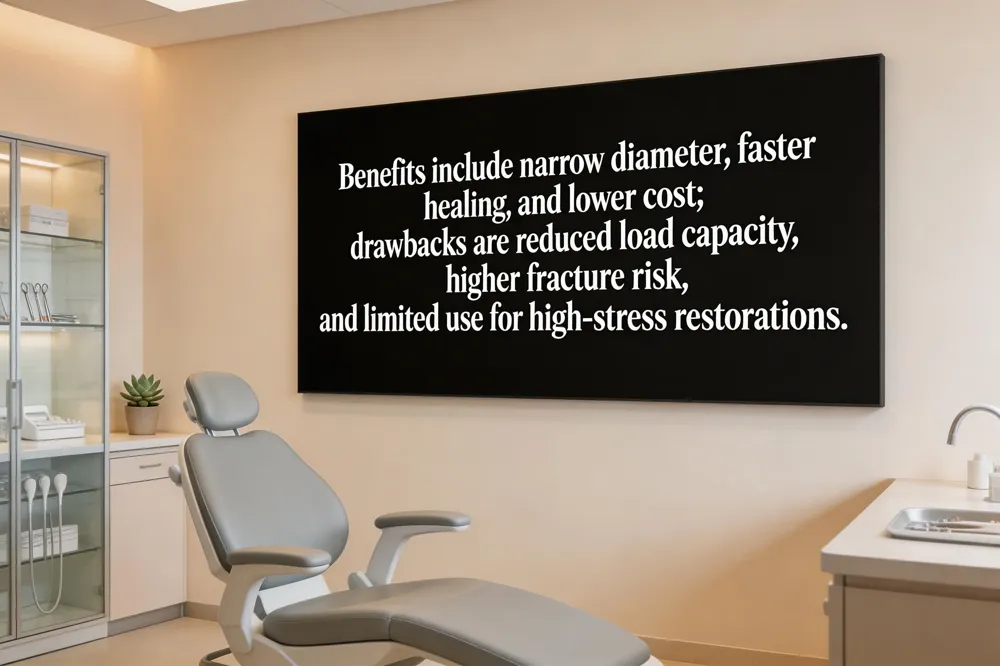
Mini dental implants are narrower (1.8‑3.3 mm) than standard implants allowing placement in narrow ridges or areas with limited bone without grafting](https://newyorkdmd.com/blog/when-are-mini-dental-implants-recommended/). The procedure is minimally invasive, often completed in a single visit under local anesthesia, and typically requires no sutures](https://newyorkdmd.com/blog/when-are-mini-dental-implants-recommended/). Healing is faster, and patients can receive a provisional crown or denture the same day](https://newyorkdmd.com/blog/when-are-mini-dental-implants-recommended/). Costs are lower because of reduced surgical time and the elimination of adjunctive procedureshttps://www.dakotaimplant.com/mini-dental-implants-a-viable-solution-for-smaller-spaces/). [Mini implants can stabilize lower dentures, support single crowns, small bridges, or act as orthodontic anchorage, helping preserve jawbone and prevent facial collapse.
Potential limitations
The reduced diameter limits load‑bearing capacity, making mini implants less suitable for molars, full‑arch prostheses, or patients with bruxism. Primary stability may be lower in very soft bone, sometimes requiring multiple implants for denture support. Their single‑piece design can complicate esthetic contouring and angle correction, and there is a higher risk of fracture or loosening over time. Success hinges on meticulous oral hygiene and regular check‑ups.
Impact on treatment planning
Clinicians must assess bone volume, density, and functional demands via CBCT or panoramic imaging[https://keiderdds.com/the-mini-dental-implant-process-a-step-by-step-guide/]. Mini implants are ideal for patients with limited bone, narrow inter‑tooth spaces, or those seeking a less invasive, cost‑effective solution. For high‑stress restorations or severe bone loss, conventional implants or grafting may be preferred.

The 3 × 3 rule for dental implants is a guideline used when planning dental‑implant placement. It states that there should be at least 3 mm of vertical bone height above the implant platform and a minimum of 3 mm of horizontal bone thickness surrounding the implant’s diameter. These dimensions provide enough bone to achieve solid osseointegration and to protect the implant from perforation or loss of stability. Clinicians use the rule to evaluate whether a site can safely receive an implant or if bone grafting is needed. Following the 3 × 3 rule helps ensure long‑term function and durability of the restored tooth.
The 50‑40‑30 rule describes the ideal proportion of visible tooth width in an aesthetic smile: the central incisors should occupy roughly 50% of the total visible width, the lateral incisors about 40%, and the canines about 30%. This guideline helps dentists achieve balanced, harmonious smile designs.
Modern imaging and digital planning—CBCT scans, intra‑oral scanners, and CAD/CAM‑generated surgical guides—allow clinicians to visualize bone volume, apply the 3 × 3 and 50‑40‑30 principles, and place mini‑implants with precision, reducing the risk of anatomical injury and enhancing both functional and aesthetic outcomes.

In the United States, a single mini dental implant typically costs about $860, with a range of $676‑$1,616 depending on the geography and any restorative work such as a crown. Insurance coverage varies; many plans treat mini implants as a restorative procedure and may reimburse part of the expense, while others offer limited or no coverage. Financing options, including in‑house plans and third‑party credit, are common to make treatment more affordable. Mini implants come in several designs: self‑drilling (self‑tapping) screws that eliminate a pilot drill; bone‑condensing implants with tapered aggressive threads to compress surrounding bone; platform‑switching implants that preserve crestal bone; and one‑piece screw‑type implants with a ball‑shaped end for immediate loading. Lengths generally run 6‑12 mm and diameters from 1.8‑3.0 mm, allowing clinicians to match the device to the patient’s bone volume and prosthetic needs.

Mini dental implants (MDIs) can be just as effective as conventional implants when used in appropriate indications. Their narrow diameter (under 3 mm) permits placement in patients with limited bone volume without grafting, and studies report success rates of 85‑95 % for MDIs placed in adequately dense bone—comparable to traditional implants in those cases. However, because MDIs lack the bulk and two‑piece abutment design of standard implants, they are not suited for high‑load molar sites, extensive full‑arch bridges, or situations demanding maximal durability. In such scenarios, regular implants remain the preferred choice.
With proper oral hygiene—brushing twice daily with a soft‑bristled brush, flossing, and regular professional clean‑ups—mini implants can remain functional for decades. Clinical data show that the titanium screw itself can survive a lifetime when osseointegration is successful; prosthetic components may need replacement after 5‑10 years, but the implant often remains stable beyond 10 years. Factors influencing long‑term outcomes include bone quality, patient health (e.g., smoking, uncontrolled diabetes), occlusal forces, and diligent maintenance. When these variables are optimized, MDIs provide reliable, long‑lasting support for single teeth, narrow gaps, or dentures stabilization.

Mini‑implants, often called temporary anchorage devices (TADs), are tiny titanium screws00822-1/fulltext) placed in the alveolar bone to serve as fixed skeletal anchors for orthodontic forces. Because they are self‑drilling and double‑threaded, they achieve primary stability under local anesthesia and can be left in place for months while the desired tooth movement occurs. The implant acts as a "reaction absorber," allowing forces to be applied directly to the screw instead of neighboring teeth, which eliminates unwanted reciprocal movement. This enables precise, isolated mechanics such as molar distalization, intrusion, uprighting of tipped teeth, and space closure without relying on patient compliance. Compared with traditional anchorage methods like headgear, elastics, or extra‑oral appliances, TADs provide absolute three‑dimensional anchorage, reduce treatment time, and avoid the discomfort and social stigma of bulky devices. The procedure is minimally invasive, often flapless, and the device is removed easily once treatment is complete, making TADs a safe, predictable, and cost‑effective option for complex orthodontic cases.
Mini‑implant candidates are adults with limited jawbone width or height, narrow inter‑tooth spaces, denture wearers needing stability, and patients who cannot undergo grafting. Benefits—minimal surgery, same‑day placement, lower cost, bone preservation—must be weighed against limits such as reduced load‑bearing capacity, loosening risk under chewing, and possible need for larger implants later. Contact Gentle Dentistry of Staten Island for an evaluation to see if this option suits your oral health goals.