Even more knowledge

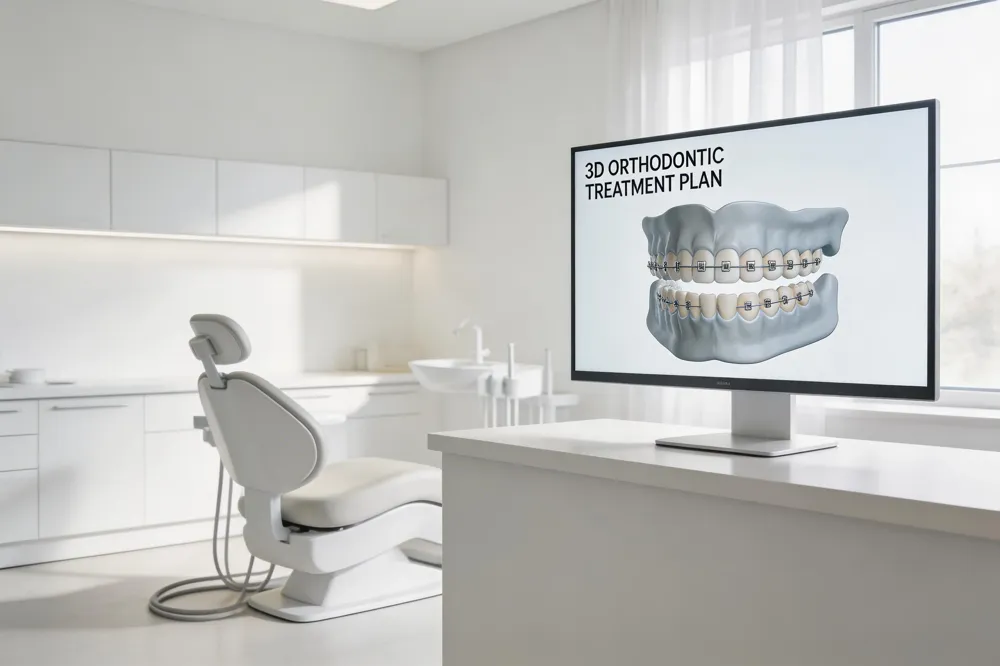
Virtual consultations have become a standard option because they let patients start treatment from home, save time and travel, and keep care safe during pandemics or busy schedules. Gentle Dentistry uses a HIPAA‑compliant video platform and the SmileSnap portal, ensuring all photos, health history forms and video calls are encrypted and stored securely. Dr. Louis Sterling and Dr. Sara Skurnick prioritize a patient‑centered philosophy: they review each submitted image, discuss concerns in a friendly video call, and present a clear, personalized treatment plan with transparent cost and financing options. By combining modern tele‑health tools with a gentle, relationship‑focused approach, Gentle Dentistry makes orthodontic care accessible, comfortable, and trustworthy for every smile.
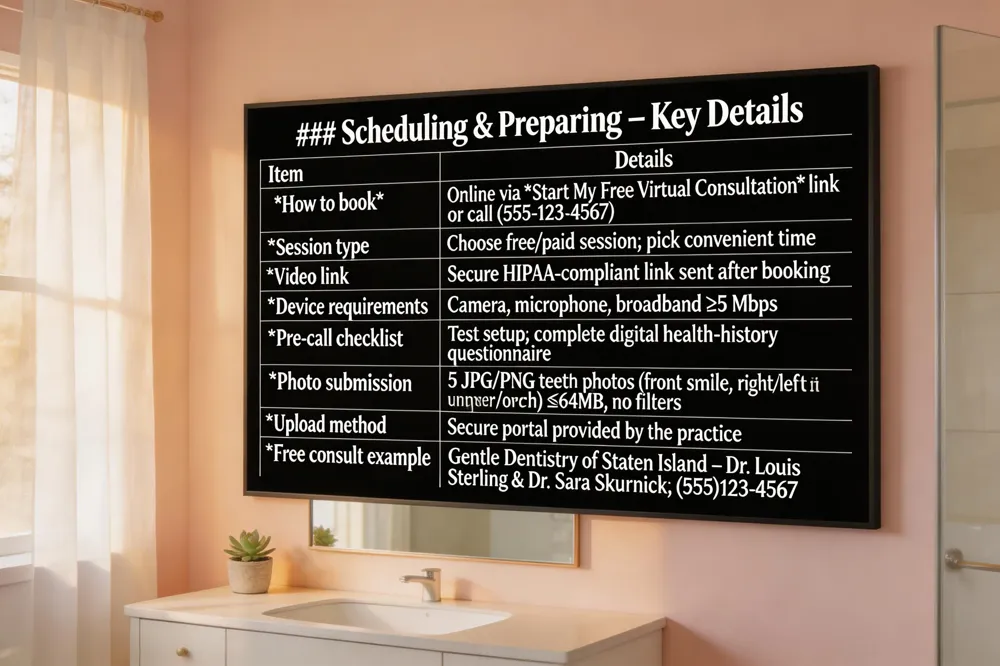 Book a virtual orthodontic visit online via Start My Free Virtual Consultation or call (555‑123‑4567). Choose a free or paid session, pick a time, and receive a secure video link with a short checklist.
You need a device with camera, microphone and broadband internet (≥5 Mbps). Test the setup using the practice’s guide and complete the digital health‑history questionnaire before the call; it records your dental and medical background.
Provide five photos—front smile, right bite, left bite, upper arch, lower arch—taken in a room with a smartphone held perpendicular to the teeth. Have a friend assist, avoid filters, and upload the JPG/PNG files (≤64 MB) via the secure portal.
Free orthodontic consultation near me
Gentle Dentistry of Staten Island offers a free visit. Led by Dr. Louis Sterling and Dr. Sara Skurnick, the team assesses your bite, explains Invisalign® or braces, and answers questions at no charge. Call (555) 123‑4567 or submit the online request form; a staff member will reply within 24 hours. The office offers a comfortable, transparent environment and modern technology for personalized care.
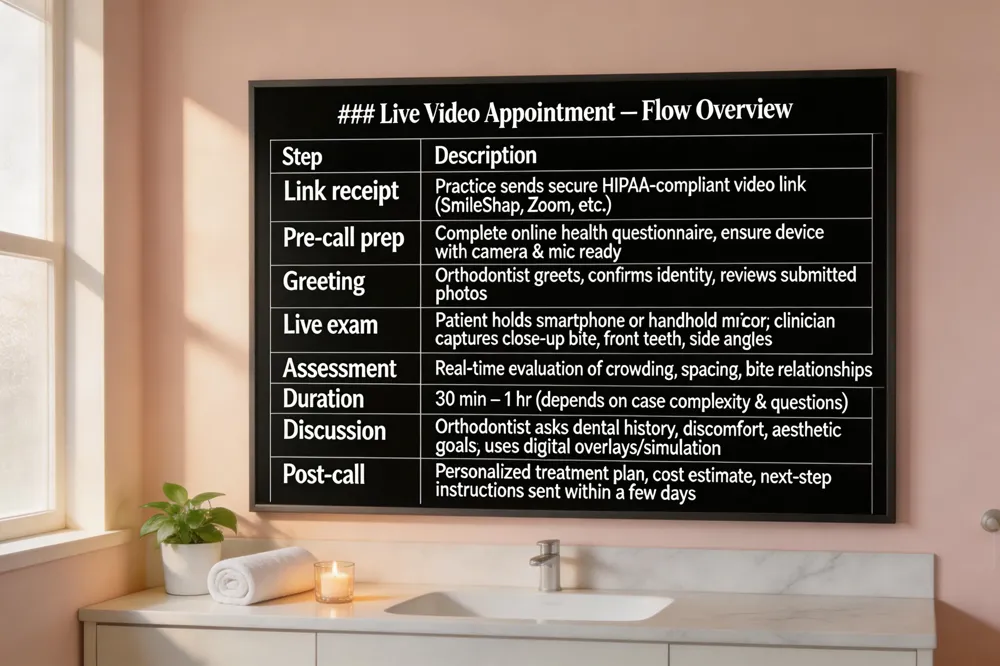 When you click the "Start my FREE Virtual Consultation" button, the practice sends you a link to a secure, HIPAA‑compliant video platform such as SmileSnap or a Zoom meeting with end‑to‑end encryption. Before the call you complete an online health questionnaire, then log in from any device with a camera, microphone and internet connection.
During the live video appointment the orthodontist greets you, reviews your submitted photos, and asks you to hold a smartphone or handheld mirror so the camera can capture close‑up views of your bite, front teeth, and side angles. This visual exam lets the clinician assess crowding, spacing, and bite relationships in real time.
Typical appointments last between 30 minutes and 1 hour; the exact length depends on case complexity, the number of photos you provide, and how many questions you have. Simpler cases may finish near the 30‑minute mark, while detailed discussions of treatment options, cost estimates, and financing can extend the session.
The orthodontist asks targeted questions about your dental history, any discomfort, and your aesthetic goals, then explains findings using digital overlays or simulation tools. After the call you receive a personalized treatment plan, cost estimate, and next‑step instructions—often within a few days—so you can decide whether to schedule an in‑person exam for final diagnostics.
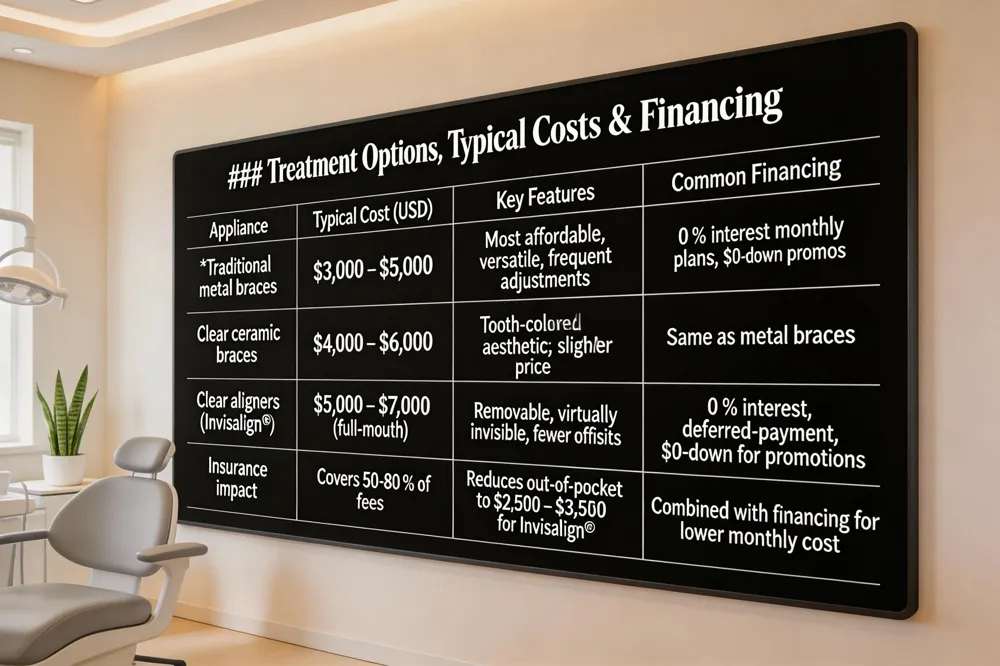 During a virtual orthodontic consultation the orthodontist compares three main appliance families: traditional metal braces, clear ceramic braces, and clear‑aligner systems such as Invisalign®. Metal braces are the most affordable and versatile, while ceramic braces offer a tooth‑colored aesthetic with a slightly higher price. Invisalign® provides a removable, virtually invisible option that often requires fewer office visits but carries a premium cost.
Cost estimates are generated on the spot by reviewing the patient’s digital photos, health questionnaire, and any uploaded X‑rays or scans. The orthodontist uses practice‑specific pricing tables and insurance contracts to calculate a transparent estimate that includes the appliance, lab fees, and expected number of visits.
Most practices present insurance coverage details, financing plans, and $0‑down options during the same video call. Common financing includes 0 % interest monthly plans or deferred‑payment programs, and many offices offer $0‑down promotions for Invisalign®.
Invisalign® treatment typically ranges from $5,000 to $7,000 for a full‑mouth case. Mid‑range $5,000 is average for moderate complexity; milder cases may be $1,500‑$4,500, while extensive cases exceed $7,000. With dental insurance covering 50‑80 % of orthodontic fees, out‑of‑pocket costs can drop to $2,500‑$3,500 or less. At Gentle Dentistry of Staten Island we’ll review your insurance, propose financing, and help you decide if $5,000 is a reasonable investment for your smile.
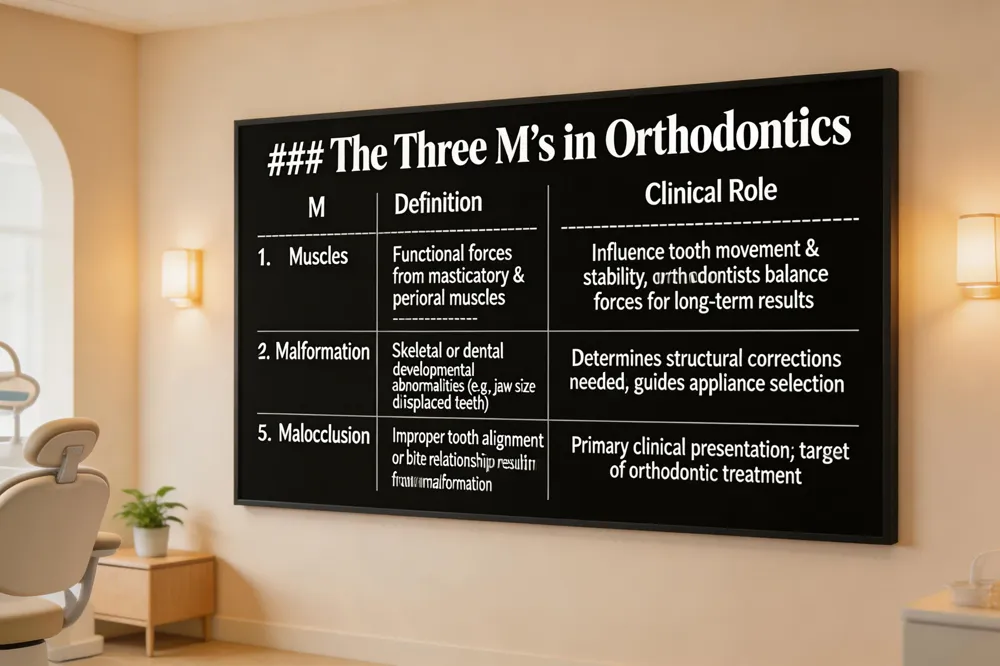 What are the 3 M's in orthodontics? The “three M’s” are Muscles, Malformation, and Malocclusion. Muscles are the functional forces from masticatory and perioral muscles that affect tooth movement and stability. Malformation refers to skeletal or dental developmental abnormalities such as jaw size discrepancies or misplaced teeth. Malocclusion is the clinical result—improper tooth alignment or bite relationship—that arises from the interaction of muscles and skeletal malformations. Orthodontists evaluate all three to design a plan that corrects structural problems while establishing balanced muscle forces for long‑term stability.
Can orthodontics fix an underbite? Yes. An underbite can be corrected with braces, elastics, a facemask, or, in severe cases, orthognathic surgery. The chosen appliance depends on the severity, patient age, and growth potential. Treatment aims to achieve a functional bite and an aesthetically pleasing smile while coordinating muscle and skeletal changes.
What are the disadvantages of digital orthodontics? Digital models offer speed and visual aid, but they lack tactile feedback, can be costly to produce, and cannot be mounted on a physical articulator for certain appliance fabrications. Consequently, for complex cases orthodontists still rely on traditional physical models and clinical judgment to ensure accuracy and optimal outcomes.
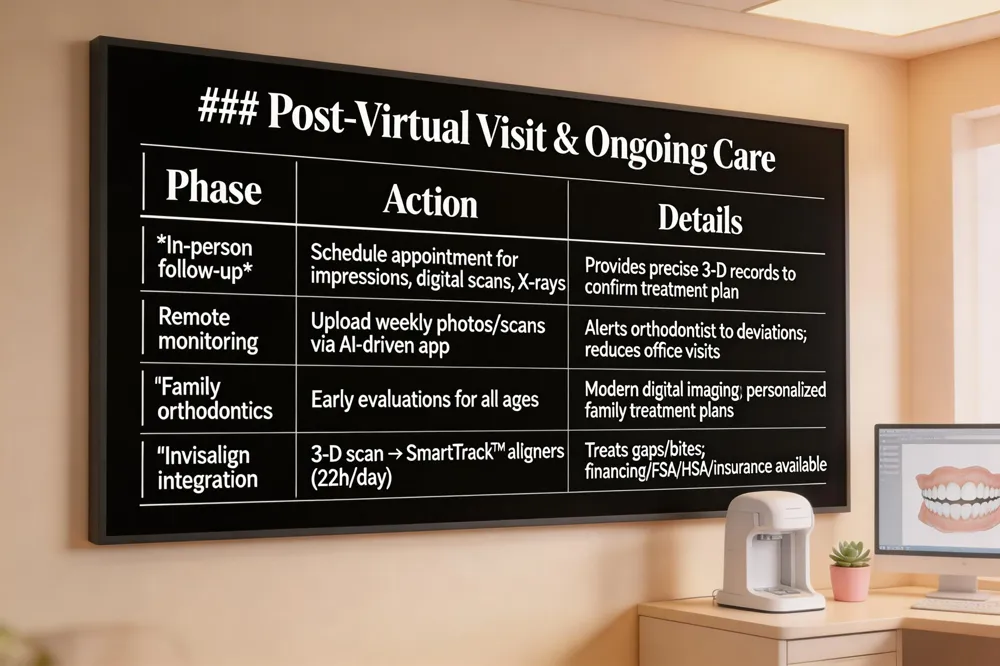 After the virtual consult, the orthodontic team will arrange an in‑person appointment for any necessary impressions, digital scans, or X‑rays. These records give a precise 3‑D view of the teeth and bite, allowing the clinician to confirm the preliminary plan and create a definitive treatment timeline.
During active treatment, many practices use AI‑driven remote‑monitoring apps that let patients upload weekly photos or scan their aligners. The software alerts the orthodontist to any deviations, so adjustments can be made without frequent office visits, saving time and reducing exposure to illnesses.
Family Orthodontics Gentle Dentistry of Staten Island offers comprehensive family orthodontics that address the unique needs of children, teens, and adults. Our team conducts early evaluations to detect bite issues promptly, allowing for timely, effective interventions such as traditional metal braces, clear ceramic braces, or Invisalign® aligners. Each treatment plan is personalized, using modern digital imaging and gentle techniques to ensure comfort and optimal results for every family member. We prioritize a transparent, patient‑centered approach, explaining all options and progress every step of the way. With a warm, relationship‑focused environment, we help families achieve healthy, confident smiles together.
Invisalign Integration Invisalign is a clear‑aligner system that gently and gradually moves teeth into their desired positions using a series of custom‑made, removable trays. The aligners are made from patented SmartTrack™ material, which delivers more constant forces for faster, more comfortable, and more predictable results than traditional braces. Treatment begins with a 3‑D digital scan of your mouth, followed by a personalized treatment plan and a set of aligners that are typically worn 22‑hour a day for about one week each. Invisalign works for kids (age 6+), teens, and adults, and can address a wide range of issues including gaps, crowding, overbites, underbites, and crossbites. Financing options, FSA/HSA reimbursement, and many insurance plans can cover a portion of the cost, making a beautiful, discreet smile more affordable.
Your virtual orthodontic journey begins with a click on Gentle Dentistry’s website, where you schedule a video appointment and receive instructions for uploading five required photos and completing a health questionnaire. Within minutes the practice’s secure platform connects you to a licensed orthodontist who reviews your images, asks a few oral‑health questions, and conducts a visual assessment using your webcam or a handheld mirror. The specialist then explains treatment options—traditional braces, clear aligners, or hybrid appliances—outlines estimated duration, cost, and financing, and answers any concerns in real time. Throughout the process Gentle Dentistry’s team maintains a gentle approach, ensuring comfort and transparency. Ready to start? Click the “Free Virtual Consultation” button today and take the first step toward your smile.