Even more knowledge

Tooth‑Owned Restoration (TOR) is a minimally invasive restorative technique that uses a patient’s own natural tooth structure as the primary support for a new restoration, preserving as much healthy enamel and dentin as possible. Within the broader field of restorative dentistry, TOR sits alongside fillings, crowns, bridges, and implants as a conservative alternative for Class I and II cavities, small cracks, or fractured cusps where sufficient tooth tissue remains. The approach offers several advantages: it reduces the need for extensive tooth reduction, lowers material costs, maintains proprioceptive feedback, and often results in less postoperative sensitivity. Modern digital tools—such as intra‑oral scanners, CAD/CAM milling, and 3‑D imaging—enable precise mapping of the remaining tooth anatomy, allowing clinicians to design and fabricate highly accurate, shade‑matched composite or ceramic restorations that fit seamlessly. By integrating digital workflow with a gentle, tissue‑preserving philosophy, TOR delivers durable, aesthetic outcomes while honoring the principles of biologically respectful dentistry.

Tooth‑Owned Restoration (TOR) is a minimally invasive technique that uses the patient’s own natural tooth structure as the primary support for a restoration. After a conservative removal of decay, the remaining healthy enamel and dentin are bonded with high‑strength composite resin or CAD/CAM‑fabricated ceramic inlays/onlays using a dual‑cure adhesive system (often a self‑etch primer with a universal bonding agent). This approach contrasts with traditional fillings, crowns, or implants, which rely on bulkier restorative materials or surgical placement of titanium posts.
Definition and core concept of TOR – TOR preserves as much natural tooth as possible, rebuilding the lost portion directly on the existing tooth.
Materials and bonding protocols – Light‑cured composite resins, lithium‑disilicate ceramics, and fiber‑reinforced posts are bonded after acid etching and adhesive application, creating a micromechanical and chemical seal.
Comparison with fillings, crowns, and implants – Fillings address small cavities; crowns require full‑coverage preparation; implants replace the entire root with a titanium fixture. TOR sits between these options, offering a restoration that is more conservative than a crown yet stronger and more aesthetic than a simple filling.
Advantages for tooth vitality and aesthetics – By retaining natural dentin and enamel, TOR maintains proprioception, reduces postoperative sensitivity, and yields a seamless color match. The technique also lowers cost, shortens chair time, and aligns with gentle‑dentistry principles.
What does ‘tooth restoration’ mean? Tooth restoration repairs, rebuilds, or replaces damaged or missing teeth to restore function, health, and appearance.
How does a tooth restoration differ from a filling? A restoration is a broad term for any rebuild (crowns, bridges, on‑lays, implants), while a filling is a specific, localized repair for small cavities.
What is another name for restorative dentistry? It is often called prosthetic or prosthodontic dentistry.
How does restorative dentistry relate to prosthodontics? Restorative dentistry repairs damaged teeth; prosthodontics is the specialized branch focused on complex replacements such as bridges, dentures, and implant‑supported prostheses.
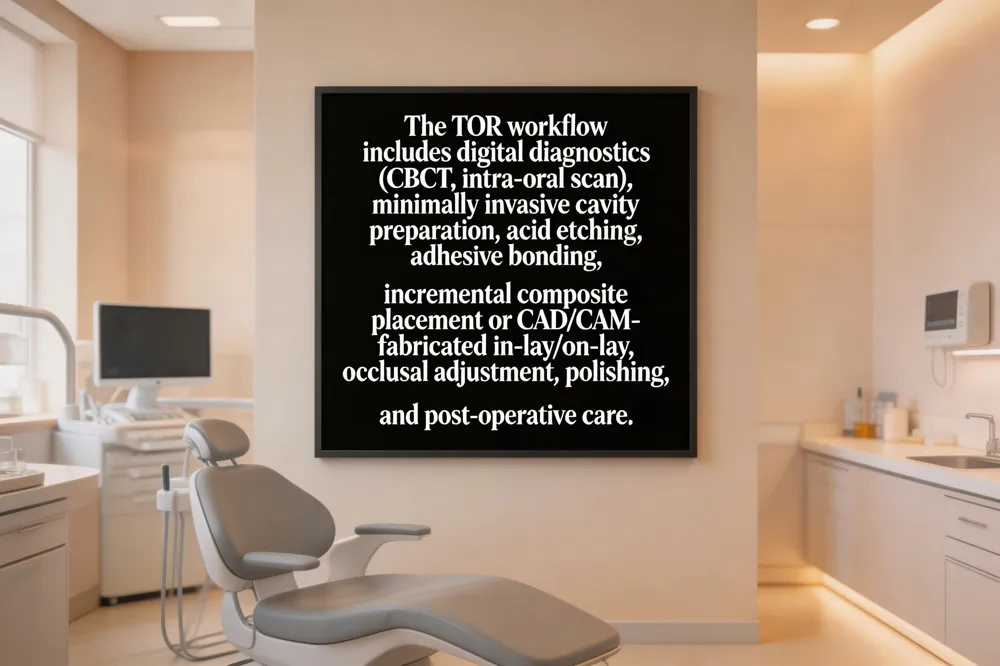
A Tooth‑Owned Restoration (TOR) begins with a comprehensive exam and digital imaging—CBCT scans and an intra‑oral scanner—to map decay, tooth anatomy, and bone support. The dentist then performs a minimally invasive cavity preparation, using ultrasonic or laser tips to remove only diseased tissue while preserving healthy enamel and dentin. After isolation, the prepared surfaces are etched with phosphoric acid, a bonding agent is applied, and high‑strength composite resin is placed incrementally, each layer cured with an LED light to minimize shrinkage stress. For larger lesions, a CAD/CAM workflow creates an indirect in‑lay or on‑lay: the digital impression guides precise milling of a ceramic or composite restoration that matches the tooth’s shade and morphology. Once fabricated, the restoration is bonded to the tooth, adjusted for occlusion, and polished. Post‑operative care includes a soft diet for 24–48 hours, meticulous oral hygiene, and follow‑up visits to monitor the bond and address any sensitivity. This conservative, technology‑driven sequence preserves natural tooth structure while delivering durable, aesthetic results.

Traditional crowns versus Tooth‑Owned Restoration (TOR) on‑lays: A full‑coverage crown removes most of the healthy enamel and dentin to encase the tooth, while Tooth‑Owned Restoration (TOR) conservatively prepares only the damaged portion and bonds a high‑strength composite or ceramic inlay directly to the remaining tooth structure. TOR preserves more natural tissue, often reducing postoperative sensitivity and chair time.
Implant‑supported restorations: Implants replace the entire tooth root with a titanium post and support a crown, bridge, or denture, offering superior longevity and bone preservation but requiring surgery and a healing period. TOR provides a non‑surgical alternative when sufficient tooth structure remains, delivering comparable aesthetics with lower cost and faster delivery.
Prosthodontic specialty: Restorative dentistry is the domain of prosthodontists—specialists trained to rebuild and replace teeth. General dentists with advanced training also perform TOR and other restorative procedures.
Longevity and patient comfort: Clinical studies show TOR restorations achieve 85‑95% survival at five years, rivaling traditional crowns while maintaining proprioception and reducing discomfort.
How does a tooth restoration differ from a filling? A filling seals a small cavity; a restoration rebuilds extensive damage with stronger materials such as onlays, crowns, or implants.
What does ‘tooth restoration’ mean? It is the repair, rebuild, or replacement of a damaged or missing tooth to restore function and appearance.
Is gentle dentistry more expensive than traditional care? It may carry a modest premium for advanced technology and comfort features, but insurance acceptance and financing keep out‑of‑pocket costs comparable.

Dental tori are harmless bony outgrowths that appear on the roof of the mouth (palatal torus) or on the floor of the lower jaw (mandibular torus). They are usually discovered during routine exams and cause no problems unless they become large enough to irritate soft tissue, trap food, interfere with dentures, or affect speech. When such issues arise, surgical removal is indicated; otherwise a watch‑and‑wait approach with good oral hygiene is sufficient.
The most common contributors to mandibular tori are genetic predisposition, chronic mechanical stress such as bruxism, local irritation, and, less often, systemic hormonal imbalances. These growths are benign and never become cancerous.
Removal is performed by an oral surgeon or a general dentist with advanced oral‑surgery training. The procedure uses local anesthesia, often supplemented with IV sedation for anxious patients or larger lesions. In cases where the removed bone is harvested for autogenous grafting, the cortical and cancellous tissue from the torus provides an excellent source for periodontal or implant site augmentation.
Costs in the United States range from $500 to $1,500 per site; Gentle Dentistry of Staten Island typically bills $600–$800. Recovery is brief—patients resume a soft diet for 24‑48 hours, maintain gentle oral hygiene, and schedule a follow‑up in one‑two weeks.
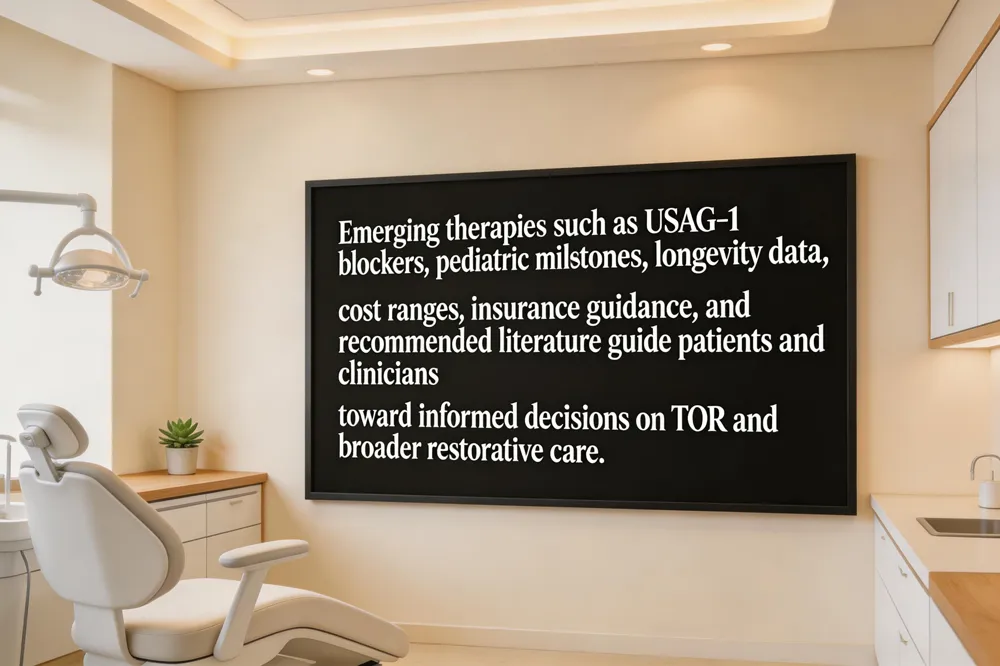
Emerging tooth‑regrowth therapies: Japanese researchers are in human trials of a USAG‑1 blocker that reactivates dormant tooth buds; they target market release by 2030 pending approval.
Pediatric dentistry milestones: The Rule of 7 marks age 7 as the shift from primary to permanent teeth when baby teeth fall out and first molars erupt.
Pain, longevity, and cost: Restorations use anesthesia, so procedure pain is minimal; soreness may follow. Fillings last 7–12 years, porcelain crowns 10–15 years, zirconia up to 20 years. Rehab ranges $15,000–$80,000+.
Insurance and finding a restorative dentist: Gentle Dentistry of Staten Island accepts plans (Delta, MetLife, Cigna, etc.) and can be located via directories, referrals, or insurer lists.
Recommended literature: Fundamentals of Fixed Prosthodontics, Restorative Dental Materials, Phillips’ Science of Dental Materials, Biomimetic Restorative Dentistry, Posterior Direct Restorations, Composite Inlays and Onlays.
Gentle Dentistry reputation: Led by Dr. Louis Sterling and Dr. Sara Skurnick, practice is praised for its gentle approach.
Tooth‑Owned Restoration preserves natural tooth structure, reduces invasiveness, and offers durable, aesthetic results with lower cost and faster healing. Our practice embraces patient‑centered gentle dentistry, using digital imaging and minimal‑prep techniques for comfort and confidence. Call today to schedule your personalized consultation and experience compassionate, cutting‑edge care in a supportive environment.