Even more knowledge

The core principle of minimally invasive dentistry (MID) is tissue preservation: only decayed tissue is removed while healthy enamel and dentin are left untouched. This conservative approach aligns with patient‑centered benefits such as reduced pain, lower postoperative sensitivity, shorter chair time, and a more natural aesthetic result. By emphasizing early detection and preventive measures—sealants, fluoride varnish, and remineralization therapies—MID bridges the gap between prevention and restorative care, allowing clinicians to intervene before lesions require extensive removal. The overall impact on oral health is profound: preserving natural tooth structure maintains strength, reduces the cycle of larger future interventions, and supports long‑term function and aesthetics while delivering higher patient satisfaction.
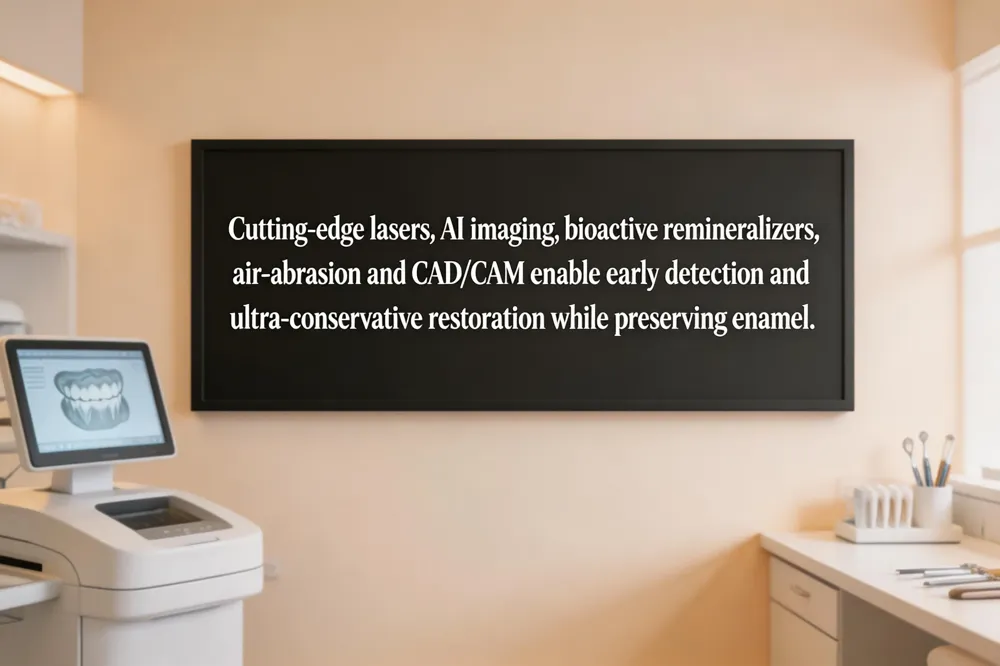
Recent advances in minimally invasive dentistry focus on early detection and preservation of healthy tooth structure. Laser‑fluorescence devices and AI‑enhanced digital imaging now reveal carious lesions at the microscopic stage, allowing clinicians to intervene before extensive decay occurs. Bioactive materials such as silver diamine fluoride, resin infiltrants, and calcium‑phosphate‑based agents promote remineralization and arrest lesions without the need for drilling. Air‑abrasion and micro‑abrasion provide precise, conservative removal of only diseased tissue, while chair‑side CAD/CAM systems enable rapid design and placement of restorations that respect remaining enamel and dentin. The emergence of 3‑D printing of provisional restorations further streamlines workflows, delivering accurate, tooth‑conserving temporaries in a single visit. Laser‑assisted procedures reduce trauma by eliminating vibration and heat associated with traditional drills, often requiring little or no anesthesia and resulting in faster healing. Together, these technologies create a patient‑centered, gentle dental experience that maintains natural tooth structure, lowers postoperative sensitivity, and improves long‑term oral health outcomes.

Minimally invasive endodontics focuses on preserving as much natural tooth structure as possible while effectively eliminating infection. conservative canal preparation with nickel‑titanium (NiTi) rotary files allows clinicians to negotiate root canals with minimal dentin removal, maintaining the tooth’s intrinsic strength. High‑magnification operating microscopes combined with ultrasonic activation further enhance precision, enabling the removal of only friable tissue and the preservation of healthy dentin and pulp remnants. Advanced imaging—particularly cone‑beam computed tomography (CBCT) and 3‑D visualization—provides a detailed map of the canal anatomy, guiding targeted tissue removal and reducing the risk of procedural errors or unnecessary tooth reduction.
Regenerative endodontic procedures (REPs) represent a paradigm shift: instead of filling the canal with inert material, REPs stimulate the body’s own healing mechanisms to regenerate pulp‑like tissue, reinforcing the tooth from within and often avoiding the need for a traditional crown. Together, these technologies translate into significant patient benefits: reduced postoperative sensitivity, shorter chair‑time, and faster overall recovery. By integrating conservative preparation, magnification, ultrasonic activation, precise imaging, and biologic regeneration, modern endodontics delivers gentle, durable, and tooth‑preserving care that aligns with the broader goals of minimally invasive dentistry.
Gentle Dentistry of Staten Island is a legitimate practice led by Dr. Louis Sterling, DDS, and Dr. Sara Skurnick, DDS. Both dentists hold active New York State dental licenses, are members of the American Dental Association, and have decades of combined experience in adhesive and biomimetic dentistry. Their board‑certified expertise is reflected in the practice’s adherence to OSHA and CDC infection‑control standards and the use of state‑of‑the‑art digital imaging, intra‑oral scanners, CAD/CAM milling, and laser‑assisted cavity preparation. These technologies enable precise, minimally invasive treatments that preserve natural tooth structure and reduce the need for anesthesia. The office environment is deliberately calming—quiet music, noise‑cancelling headphones, and a gentle, patient‑centered communication style that eases anxiety. Transparent treatment planning, shared decision‑making, and clear cost explanations foster high patient satisfaction, as reflected in glowing Google and Healthgrades reviews.
Is Gentle Dental legit?
Gentle Dentistry of Staten Island is a legitimate dental practice. It is led by board‑certified dentists Dr. Louis Sterling and Dr. Skurnick, who have decades of combined experience. The office holds a current New York State dental license, follows OSHA and CDC infection‑control standards, and is actively listed with the American Dental Association. Patient testimonials on Google and Healthgrades are overwhelmingly positive, highlighting the gentle approach and modern technology. While other “Gentle Dental” locations across the U.S. have mixed online ratings, the Staten Island practice consistently meets professional and regulatory standards, confirming its legitimacy.
What is a gentle dentist?
A gentle dentist prioritizes comfort and emotional well‑being through calming communication, personalized sedation options, and minimally invasive techniques. Using digital imaging, laser tools, and needle‑free anesthetics, they reduce pain and accelerate healing while delivering high‑quality care. By listening attentively and building trust, they manage dental anxiety, ensuring each visit feels safe, relaxed, and patient‑centered.
Preserving a natural tooth begins with diligent daily oral hygiene. Brush twice a day with a soft‑bristle toothbrush and fluoride toothpaste, and floss or use interdental cleaners once daily to remove plaque from the gum line and between teeth. Schedule regular dental check‑ups and professional cleanings so early decay or gum disease can be detected and treated with preventive measures such as fluoride varnish, sealants, or silver‑diamine fluoride (SDF). Limit sugary and acidic foods and drinks, stay well‑hydrated, and maintain a balanced diet rich in calcium and vitamin D to support enamel and bone health.
The 3‑3‑3 rule offers an extra‑cautious routine: brush three times a day, spend three minutes each session, and wait at least three hours after eating before bedtime to let saliva neutralize acids. While many clinicians still recommend twice‑daily brushing for two minutes, the 3‑3‑3 approach can provide added protection for high‑risk patients.
Non‑invasive dental procedures focus on preserving tooth structure while preventing or reversing early decay. Options include professional fluoride varnish, SDF applications, povidone‑iodine rinses, guided enamel regeneration with self‑assembling peptides, and sealants. Cosmetic choices such as professional whitening, ultra‑thin veneers, and clear aligner therapy also avoid extensive enamel removal.
Remineralization is insufficient when a cavity has progressed to an actual hole in enamel. At that point, the decay must be removed and the tooth restored, underscoring the importance of early detection and regular monitoring.

Minimally invasive implant placement is reshaping restorative care. Small‑diameter, flap‑less fixtures—often under 3 mm—can be inserted with guided‑surgery or punch techniques, eliminating incisions, stitches, and extensive grafting. At Gentle Dentistry of Staten Island, Dr. Louis Sterling and Dr. Sara Skurnick use these protocols to place implants in a single chair‑side visit, cutting cost and healing time while allowing immediate provisional restorations.
Emerging bio‑active and smart restorative materials promise longer‑lasting, tooth‑like performance. Biomimetic composites and glass‑ionomer cements release fluoride and mimic enamel‑dentin flexure, reducing secondary decay and preserving vitality. Digital workflows, 3D printing, and AI‑driven diagnostics further enhance precision, supporting ultra‑conservative preparations.
Regenerative medicine is aiming to regrow teeth by 2030. Early‑stage trials in Japan target the USAG‑1 protein to trigger a third dentition; promising animal data suggest a future drug could enable natural tooth regeneration, though safety and regulatory approvals remain pending.
Cosmetic dentistry continues to evolve. While Gentle Dentistry offers gentle, patient‑centered aesthetic services, the island’s most celebrated cosmetic specialist is Dr. Anne Gershkowitz, DDS, whose advanced aesthetic fellowship and minimally invasive techniques deliver natural‑looking smile makeovers.
Overall, the integration of minimally invasive implants, smart biomimetic materials, and regenerative therapies is poised to extend tooth longevity, improve oral health, and expand treatment options for patients worldwide.
Preserving natural tooth structure is the cornerstone of long‑term oral health: it maintains enamel strength, reduces the risk of future decay, and lowers the likelihood of extensive restorations such as crowns or implants. At Gentle Dentistry of Staten Island we are committed to a patient‑centered model that blends gentle communication with minimally invasive techniques—air‑abrasion, laser cavity preparation, adhesive composites, and digital diagnostics—to conserve as much healthy tissue as possible. Regular six‑month check‑ups enable early detection of caries, allowing preventive interventions like sealants, fluoride varnish, and resin infiltration that keep teeth healthy and avoid unnecessary drilling. We invite you to experience our calm, comfort‑focused environment and discover how modern, conservative dentistry can protect your smile for years to come.