Even more knowledge


The purpose of this article is to help patients and clinicians understand the key differences between immediate and delayed dental implant loading, and to guide decision‑making based on current evidence. Implant loading protocols fall into two main categories: immediate loading, where a provisional restoration is placed within 48‑72 hours of surgery, and delayed (conventional) loading, which allows a healing period of 3‑6 months before the prosthesis is attached. Both approaches aim for successful osseointegration, but they differ in treatment time, surgical appointments, and the biomechanical requirements for primary stability. For residents of Staten Island, these nuances are especially relevant because local practices such as Gentle Dentistry of Staten Island offer both options, leveraging CBCT imaging and guided surgery to tailor treatment to each patient’s bone quality, oral health, and lifestyle preferences. Understanding the advantages, limitations, and patient‑selection criteria for each protocol empowers individuals to choose the most appropriate and comfortable path to a restored, functional smile.

Immediate loading places a provisional restoration within 48–72 hours of implant surgery while the fixture is still integrating with bone. Delayed loading waits 8–16 weeks—often 3–6 months—until osseointegration is complete before attaching the final prosthesis. The key biological requirement for immediate loading is sufficient primary stability (insertion torque ≥ 35 Ncm or ISQ > 65) to keep micromotion below 150 µm, which preserves the blood clot and allows bone‑to‑implant contact to mature into a rigid interface. Delayed loading allows undisturbed healing, especially in softer bone (Misch Types III–IV) or when risk factors such as uncontrolled diabetes, heavy smoking, or severe bruxism are present. Immediate‑load (same‑day) implants let patients leave the office with a functional tooth, shortening treatment time and improving early aesthetics, but they demand careful case selection, a well‑designed provisional that distributes forces, and a soft‑diet period. Traditional implants follow a staged protocol, offering a more conservative approach that can be safer for compromised sites and often yields slightly higher long‑term survival. At Gentle Dentistry of Staten Island we evaluate bone quality, systemic health, and patient goals to recommend the optimal loading protocol.

Randomized prospective trials of single‑tooth mandibular molar implants show 100 % survival at six years for both immediate‑loaded (prosthesis within 48 h) and delayed‑loaded (3‑month healing) groups, with no statistically significant differences in marginal bone loss, probing depths, or mobility. Systematic reviews confirm comparable five‑year survival rates of 95 %–98 % for immediate loading when primary stability (≥35–40 Ncm torque or ISQ > 65) is achieved, matching delayed protocols. Immediate loading thus offers a success rate ranging from 92.4 % to 100 %, comparable to conventional loading. An immediate dental implant is placed at the same appointment as tooth extraction, allowing the patient to leave with a functional, esthetic provisional restoration. This approach reduces treatment time, visits, and postoperative discomfort while maintaining long‑term predictability when bone quality and primary stability are sufficient.

Bone healing after implant placement follows a predictable sequence: a blood clot forms in the osteotomy, is replaced by granulation tissue, and finally matures into bone that bonds to the implant surface (osseointegration). Clinical studies consistently show that marginal bone loss is minimal for both immediate loading and delayed loading protocols when primary stability is achieved. In a six‑year randomized trial of mandibular first‑molar implants, immediate loading produced 1.1 mm mesial and 1.15 mm distal bone loss at 1 month, which decreased to 0.1 mm and 0.15 mm, respectively, at 6 months (p < 0.01). Delayed loading showed 0.95 mm and 0.82 mm loss at 1 month, stabilizing at 0.15 mm on both sides by 6 months (p < 0.02). Other trials report 1‑year marginal loss of 0.19 ± 0.44 mm (immediate) versus 0.25 ± 0.28 mm (delayed) with no significant difference (source). Overall, immediate loading may exhibit slightly higher early bone loss, but both protocols converge to comparable marginal bone levels within the first year, supporting similar long‑term bone preservation.

Immediate implant placement after extraction is possible when the socket has at least 5 mm buccolingual width and 12 mm height, bone is type I‑II (dense) or grafted, and primary stability of ≥35 Ncm torque or ISQ > 65 can be achieved. Good oral hygiene, controlled periodontal disease and no active infection are required. If the site shows type III‑IV bone, major loss, or systemic issues like uncontrolled diabetes, a delayed protocol with grafting and 3‑6 months healing is safer.
Delayed placement lets the socket mature, allowing bone remodeling and graft integration, reducing micromotion and improving marginal bone stability, especially in compromised sites.
Immediate implant after extraction – Yes, if bone volume, density and primary stability are sufficient; otherwise a staged approach is chosen.
Delayed implant placement after extraction – Used when bone needs healing or augmentation, offering better stability and lower early‑failure risk.
Immediate loading implants: review of the critical aspects – Success depends on high primary stability (≥35 Ncm torque), good bone quality, appropriate implant design and occlusal control; when met, survival matches delayed protocols but early failure risk is slightly higher.

Pre‑operative digital planning and CBCT assessment CBCT evaluates bone volume (>5 mm buccolingual, >12 mm height) and quality (Misch –II). Virtual planning selects a tapered, rough‑surface implant ≥3 mm.
Achieving primary stability Undersized drilling compresses bone to reach insertion torque ≥35 N·cm (often 40–50 N·cm) and ISQ > 65, keeping micromotion below 150 µm.
Provisional restoration fabrication and placement A screw‑retained temporary crown is placed within 48 h, out of occlusion, protecting the site while allowing controlled loading.
Post‑operative instructions and follow‑up schedule Soft diet, avoid parafunctional habits, use chlorhexidine rinses. Checks at 1, 2, and 6 weeks assess probing depth and mobility; final prosthesis delivered after 3–4 months once stability is confirmed.
Immediate loading implant protocol Provides functional restoration within 48 h.
What is the immediate implant loading protocol? It connects a newly placed implant to a provisional crown in occlusion within one week, requiring ≥35 N·cm torque and case selection.
Immediate vs delayed implant loading Immediate loading restores function within 48 h, reducing treatment time but demanding stability; delayed loading waits 3–6 months, offering a more forgiving healing period.

Immediate loading implants let patients receive a functional, aesthetic tooth replacement in a single visit, dramatically reducing overall treatment time and the number of appointments.
By placing a provisional or final restoration within 48 hours, the smile looks complete immediately, which preserves soft‑tissue contours and prevents migration of adjacent teeth. This rapid rehabilitation boosts confidence, improves quality‑of‑life scores, and often lowers overall costs by eliminating temporary prostheses and extra visits.
Key advantages include:
• Faster treatment – patients can leave the office with a restored tooth, saving weeks to months of healing.
• Immediate aesthetics and function – instant aesthetic and functional results.
• Soft‑tissue preservation – the implant fills the extraction socket, maintaining gingival architecture.
• Psychological benefit – reduced anxiety and higher satisfaction reported in multiple studies.
The protocol requires sufficient primary stability (insertion torque ≥35 N·cm) and good bone quality; otherwise the risk of early failure rises. Proper case selection and post‑operative care are essential to mitigate these risks.

Immediate‑loading protocols rely on high primary stability (≥35 N·cm torque or ISQ > 65) at placement. When this threshold is not met, micromovements > 150 µm can jeopardize osseointegration, disrupting the clot and favoring fibrous tissue. In a six‑year mandibular molar study, survival remained 100 % only when stability criteria were met; otherwise risk rises. Micromotion also promotes minimal marginal bone loss and possible peri‑implant radiolucency. Early prosthetic issues include prosthesis fracture, abutment screw loosening, and early adjustments due to soft‑tissue remodeling. Patient‑related risk factors—smoking and uncontrolled diabetes, parafunctional habits, poor oral hygiene—amplify these problems.
Disadvantages of immediate loading implants: higher early‑failure risk, increased infection potential, need for meticulous case selection, and possible prosthetic complications.
Immediate loading places a provisional restoration within 48 hours , while delayed loading waits 3–6 months for osseointegration. Immediate protocols give faster function but demand higher primary stability; delayed protocols offer a more predictable healing environment.

Implant loading can be Immediate loading (prosthesis placed within 48 hours), early loading (1 week‑2 months) or conventional/delayed loading (3‑6 months). Immediate loading requires high primary stability (insertion torque ≥ 35 N·cm or ISQ > 65), adequate bone volume, and careful case selection (non‑smoker, no parafunctional habits). Early loading is used when stability is moderate, while delayed loading offers the most predictable healing environment.
Provisional restorations for Immediate loading are usually acrylic or CAD‑CAM milled crowns designed to avoid occlusal contact and lateral forces; they are splinted when multiple implants are placed to limit micromotion. A soft‑diet (no hard chewing) for 8‑12 weeks protects the healing implant.
Transition to the final prosthesis occurs after radiographic confirmation of osseointegration and stable peri‑implant tissues, typically at 3‑6 months for delayed loading cases and 6‑12 weeks for Immediate loading cases. The final restoration is fabricated with a refined occlusal scheme and bonded or screwed onto the implant, completing the restorative phase.
Immediate vs delayed implant loading ppt – Immediate loading places the prosthesis within 48 hours, offering faster function and patient satisfaction but a higher early‑failure risk if stability is insufficient; delayed loading allows complete bone remodeling and generally higher long‑term success.
Immediate dental implant – Placed at the extraction appointment, the implant can receive a temporary crown on the same day, reducing visits and treatment time while preserving tissue architecture.
Immediate loading implants ppt – Emphasizes provisional restoration design, surface treatments, and occlusal control; at Gentle Dentistry of Staten Island, a one‑stage, non‑submerged technique with a soft‑diet protocol ensures safe Immediate loading.

Immediate‑load implants are generally priced higher than conventional two‑stage protocols because the provisional crown is fabricated and placed on same day. A single‑tooth immediate‑load case typically costs $3,500–$7,000, whereas a delayed‑loading placement of the same tooth falls in the $2,800–$5,500 range. Full‑arch “teeth‑in‑a‑day” restorations run $12,000–$30,000 per arch, while a comparable delayed full‑arch may be $10,000–$25,000. Price drivers include implant system and surface treatment, abutment type, crown material (zirconia, porcelain‑fused‑metal), any bone grafting or sinus‑lift procedures, and use of workflow tools such as CBCT‑guided surgery and CAD/CAM provisional crowns. Insurance coverage varies: many dental plans treat implants as prosthetic devices and will cover a portion of the surgical fee after a 6‑ to 12‑month waiting period, but immediate‑load crown is billed separately and may be excluded. Patients can mitigate costs by using financing plans, health‑care credit cards, or asking the practice for a staged‑payment schedule that spreads the expense over 12–24 months. Exploring a health‑savings account (HSA) or flexible‑spending account (FSA) can also offset out‑of‑pocket expenses.
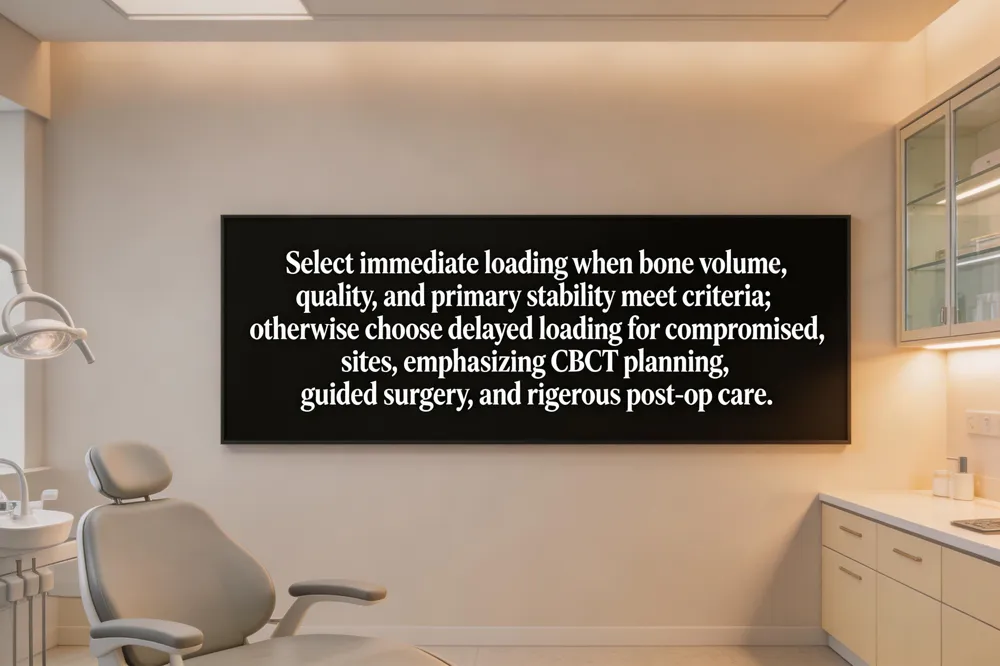
When deciding between immediate and delayed implant placement, patients should follow a clear decision‑making framework. First, evaluate clinical factors: bone volume (>5 mm buccolingual width, >12 mm height), bone quality (Misch Type I‑II, and the presence of infection or systemic disease. If the site meets these criteria and primary stability of ≥35–40 N·cm can be achieved, immediate placement offers the convenience of a single surgery, faster functional rehabilitation, and preservation of soft‑tissue contours. Conversely, delayed placement is safer when bone density is low, grafting is required, or the patient smokes heavily, as it allows undisturbed osseointegration and may lower early‑failure risk. Gentle Dentistry of Staten Island embraces this patient‑centered approach, using CBCT imaging, guided surgery, and tapered, rough‑surface implants to maximize primary stability while keeping the experience comfortable and stress‑free. After restoration, the practice emphasizes meticulous oral‑hygiene instruction, a soft‑diet period, and regular 6‑month recall visits to monitor probing depths, marginal bone levels, and prosthetic integrity, ensuring long‑term success regardless of the loading protocol chosen.
Immediate loading and delayed loading both achieve high implant survival when case selection and surgical technique are appropriate, but they differ in treatment time, patient experience, and risk profile. Immediate protocols offer same‑day function, fewer surgical visits, and faster aesthetic rehabilitation, yet they require sufficient primary stability (≥35 Ncm torque or ISQ > 65) and careful control of occlusal forces. Delayed loading provides a healing interval that can be advantageous in low‑density bone, extensive grafting, or when systemic risk factors exist, reducing early micromotion and potential failure. The decision should be guided by a comprehensive assessment of bone quality, oral hygiene, systemic health, and patient preferences. Gentle Dentistry of Staten Island conducts thorough CBCT‑guided planning, evaluates each patient’s individual risk factors, and discusses both options transparently. By tailoring the loading protocol to the patient’s anatomy and goals, the practice ensures optimal long‑term outcomes while delivering a compassionate, patient‑centered experience. This approach also promotes confidence and adherence to care.