Even more knowledge

Modern orthodontics places the patient at the center of care by offering faster, more comfortable options such as self‑ligating brackets that reduce friction, lower plaque retention, and shorten office visits. Digital workflow integration— intra‑oral scanners, CAD/CAM design, and 3‑D printing—creates patient singlespecific brackets, archwires, and clear aligners that fit precisely, cut chair‑time, and enable remote monitoring through the Internet of Dental Things. Emerging materials further enhance outcomes: 3‑D‑printed ceramic and zirconia brackets provide custom colour‑matching and fracture‑toughness; nano‑coatings (AgNP, TiO₂, gold‑oxoborate) deliver up to 78 % antibacterial protection; and smart brackets equipped with piezoresistive sensors transmit real‑time force data for AI‑guided adjustments. Together, these advances deliver a personalized, efficient, and aesthetically pleasing treatment experience.

Clinically, SLBs provide comparable treatment durations to conventional brackets—typically 12‑24 months—with mixed evidence on overall speed. They do, however, reduce the number of adjustments, improve oral hygiene by removing plaque‑trapping ligatures, and increase patient comfort. Adjustments are usually scheduled every 6‑8 weeks (≈1½‑2 months), and recent studies report average times of 19.2 months for SLBs versus 21.3 months for traditional brackets, a difference that is not statistically significant.
Patients benefit from fewer office visits, easier cleaning, and smoother force delivery. Disadvantages include higher cost, potential clip deformation leading to torque loss, and limited aesthetic color options beyond metal, tooth‑colored ceramic, or clear translucent finishes. Overall, SLBs offer a modern, low‑friction alternative that can enhance comfort and efficiency without dramatically altering total treatment time.

Modern orthodontics balances visual appeal with biomechanical precision.
Ceramic brackets have moved from traditional alumina to monocrystalline and polycrystalline forms that resist staining, improve strength, and match tooth color.
Recent 3D‑printed ceramic brackets, fabricated from glass‑ceramic ingots using lost‑wax or additive methods such as digital light processing (DLP) and material jetting (MJ), achieve shear‑bond strengths and frictional resistance comparable to commercial brackets while offering a bespoke shade that blends seamlessly with the patient’s enamel.
The color‑matching capability of these customized appliances reduces the need for later aesthetic adjustments, though exposure to coffee or red wine can affect long‑term translucency, prompting ongoing material refinements.
Lingual braces, bonded to the tongue side of teeth, provide a truly invisible solution; newer self‑ligating lingual systems mitigate tongue discomfort and improve torque expression, making them a viable aesthetic option for adult patients who demand discretion.
Clinicians seeking the most advanced orthodontic solutions can consider LightForce, a fully digital workflow that produces 3D‑printed polycrystalline alumina brackets with precise slot tolerances, resulting in fewer emergency visits and reduced debondings.
Together, these innovations illustrate how additive manufacturing and smart material engineering are reshaping aesthetic orthodontics, delivering tailored color, improved comfort, and enhanced treatment efficiency.

Smart braces are orthodontic appliances that embed nano‑electronics—such as piezoresistive or strain‑gauge sensors—directly into the bracket base or archwire. These miniature sensors measure three‑dimensional forces and moments in real time, detecting as low as 60 mN and moments down to 0.014 N·mm. The data are transmitted via a low‑power Bluetooth or NFC module to a cloud‑based platform, forming part of the Internet of Dental Things (IoDT). Once uploaded, clinicians can view force vectors, tooth‑movement trajectories, and oral‑temperature trends on a secure dashboard, enabling precise biomechanical adjustments without a physical visit. Remote‑monitoring platforms, such as DentalMonitoring and proprietary IoDT apps, allow patients to capture intra‑oral photos or scans at home; the system automatically correlates visual changes with sensor data, flagging deviations and prompting early intervention. This continuous feedback loop shortens overall treatment time, reduces emergency appointments, and improves patient comfort.
Henry Schein Orthodontics offers a comprehensive bracket portfolio—including stainless‑steel, ceramic, and self‑ligating systems like Aria and Twin Motion Pro—designed for exact slot tolerances and easy ligation. Their product line also provides a wide range of intra‑oral elastic ligatures in various sizes, colors, and fun shapes, supporting nuanced force control, bite correction, and patient engagement throughout treatment.

What are the latest trends in orthodontic bonding? Modern bonding emphasizes light‑cure, nano‑filled composites that polymerize with LED units for high bond strength and a natural tooth‑color finish. Digital intra‑oral scanners and 3‑D imaging guide precise placement, while in‑house 3‑D printing creates customized bonding trays and brackets, reducing excess material and chair‑time. Minimal‑invasive composite repairs are favored for quick fixes, and integration with patient‑engagement platforms ensures timely reminders and follow‑up to maintain bond longevity.
What are accelerated orthodontics and do they work? Accelerated orthodontics employ biologically stimulating techniques—low‑level laser therapy, high‑frequency vibration, micro‑osteoperforations, and minimally invasive surgeries such as corticotomy or piezocision—to enhance bone remodeling. Surgical adjuncts can increase tooth‑movement rates by 40‑50 %, while laser and micro‑osteoperforation protocols achieve 20‑50 % or 1.5‑2‑fold speed‑ups. Non‑invasive vibration devices show mixed results, often lacking statistically significant acceleration. Overall, acceleration can shorten treatment, especially when a surgical component is used, but outcomes vary by patient and protocol.
What are the best orthodontic elastics for bite correction? The most versatile elastics are 1/4 in (6.4 mm) and 3/16 in (4.8 mm) sizes, delivering 2.5‑4.5 oz forces when stretched threefold. For Class II/III corrections, 1/4 in elastics providing 5‑6 oz are ideal; 3/16 in elastics (4‑5 oz) suit extraction cases. Light 1/8 in elastics (1‑2 oz) fine‑tune anterior open‑bites, while larger 3/8 in box elastics (up to 6 oz) address extensive bite‑closing. Force selection should be calibrated with a correx gauge based on anchor‑point distance.
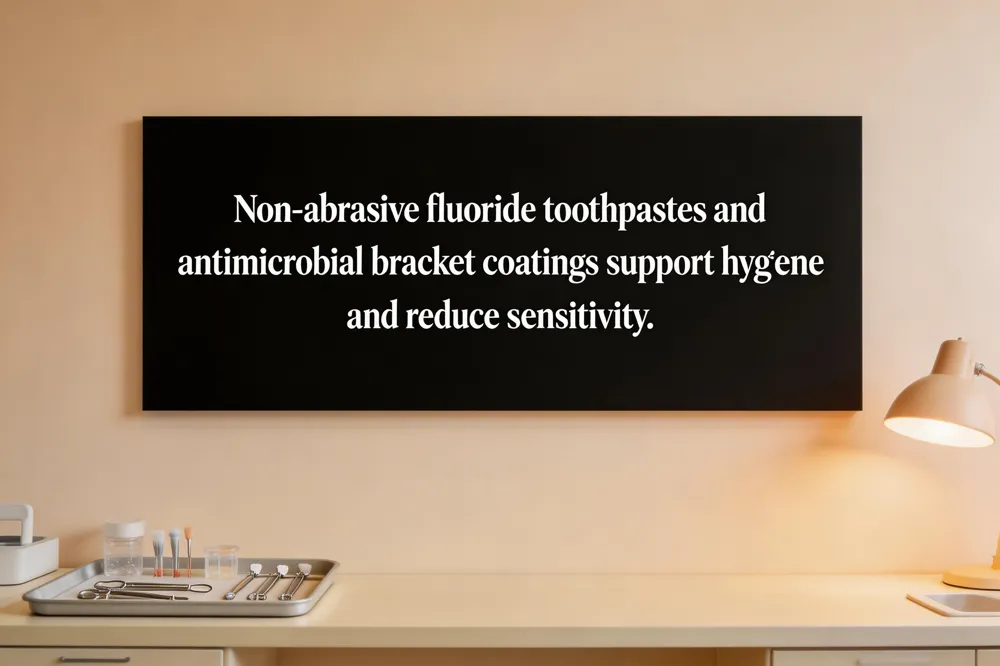
Maintaining optimal oral hygiene while wearing orthodontic appliances is essential for preventing demineralization and ensuring comfortable treatment. Bracket‑friendly toothpastes should be non‑abrasive, fluoride‑rich, and free of whitening agents that could scratch ceramic or 3D‑printed brackets. Sensodyne’s non‑whitening, fluoride‑enhanced formulas (e.g., Pronamel) meet these criteria and help reduce post‑adjustment sensitivity without compromising bracket integrity.
Oral hygiene during treatment – Brush twice daily with a soft‑bristled orthodontic brush or a powered brush equipped with a small head, and floss using a floss threader or interdental brushes to clear plaque around wires and brackets. Antimicrobial nano‑coatings (silver, TiO₂, or gold‑oxoborate) on brackets further diminish bacterial colonization, but meticulous cleaning remains the frontline defense against white‑spot lesions.
Sensitivity management – Tooth sensitivity often follows wire changes. Using a low‑abrasion, fluoride‑containing toothpaste (e.g., Sensodyne) and a desensitizing gel can calm nerves while the enamel re‑hardens around brackets.
Can I use Sensodyne if I have braces? Yes, you can use Sensodyne while you have braces. The Pronamel line (including Mineral Boost) is non‑abrasive and contains fluoride, which helps strengthen enamel around brackets and wires. Its gentle formulation also reduces tooth sensitivity that often occurs after adjustments. Because it is low‑abrasion, it won’t scratch or damage brackets or wires, making it a safe daily toothpaste for orthodontic patients. Just be sure to choose the non‑whitening, fluoride‑rich version and follow your orthodontist’s brushing recommendations.
What are the best orthodontic elastics for bite correction? The most versatile elastics for bite‑correction are the 1/4 in (6.4 mm) and 3/16 in (4.8 mm) sizes, which cover a wide range of force levels from light (≈2.5 oz) to heavy (≈4.5 oz) when stretched three times their original diameter. For Class II or Class III corrections, a 1/4 in elastic delivering 5‑6 oz (≈140‑170 g) provides the necessary en‑mass force, while a 3/16 in elastic at 4‑5 oz (≈110‑140 g) is ideal for extraction cases that require slightly less force. Anterior open‑bite or fine‑tuning adjustments are best achieved with lighter 1/8 in elastics (≈1‑2 oz) or silicone‑free options for patients with latex sensitivities. Posterior box elastics, typically 3/8 in (9.5 mm) or larger, are used for more extensive bite‑closing or posterior anchorage, delivering up to 6 oz (≈170 g). Selecting the appropriate size and force level should be guided by the measured distance between anchor points and verified with a correx gauge to ensure consistent, safe bite correction.

Invisalign fees vary by case complexity. Simple alignment may start at $2,000‑$4,500, while moderate to severe cases that need multiple aligner sets, attachments, and refinements can reach $7,000‑$8,000. Thus, $8,000 is on the higher end of the national range but reflects a comprehensive treatment rather than an arbitrary excess. Most patients offset costs through dental insurance, in‑office financing, or third‑party payment plans that spread the expense over months.
AI‑driven treatment planning now analyzes 3‑D scans and predicts tooth‑movement trajectories with up to 95 % accuracy reducing the number of mid‑course refinements and shortening overall treatment time. Integrated platforms can automatically generate optimal bracket placement, archwire sequencing, and aligner staging, giving clinicians a data‑rich roadmap while still requiring professional oversight.
Undergraduate research opportunities focus on feasible, data‑driven topics such as measuring friction differences among bracket materials, comparing aligner versus brace efficiency, evaluating patient compliance with removable appliances, or testing accelerated orthodontic techniques like micro‑osteoperforation. Studies on oral‑hygiene protocols to prevent white‑spot lesions or on the accuracy of 3‑D‑printed indirect bonding trays also provide valuable clinical insight with limited resources.

Orthodontists are increasingly recognized as frontline providers in the identification and non‑surgical management of obstructive sleep apnea (OSA). During routine examinations they assess facial growth, dental crowding, and the relationship of the mandible to the maxilla, looking for risk markers such as a narrow palate or retrognathic jaw. When these signs appear, a brief screening questionnaire and, if available, a portable home sleep test are offered before referring the patient to a sleep‑medicine physician for definitive diagnosis.
If OSA is confirmed and the case is mild to moderate, orthodontists can fabricate mandibular advancement devices (MADs). These custom‑fitted oral appliances reposition the lower jaw and tongue forward, enlarging the airway and reducing nighttime airway collapse. The design can be refined with digital scans, 3‑D printing, and clear‑aligner technology to improve comfort and compliance.
Effective treatment often requires an interdisciplinary care model. Orthodontists collaborate with sleep physicians, otolaryngologists, and maxillofacial surgeons to coordinate appliance therapy, monitor outcomes, and decide when additional interventions such as CPAP or surgery are needed. This teamwork ensures that each patient receives a comprehensive, personalized plan that addresses both dental alignment and sleep health.
Orthodontic care is entering a phase where cutting‑edge materials and digital tools converge to make treatment faster, quieter, and more personalized. Advances such as 3D‑printed ceramic and zirconia brackets, nano‑coated surfaces that inhibit Streptococcus mutans, and shape‑memory NiTi archwires provide stronger, stain‑resistant, and antimicrobial options while delivering gentle, continuous forces. Smart brackets equipped with micro‑sensors and IoDT connectivity allow clinicians to monitor force vectors in real time, reducing office visits and enabling remote adjustments. At Gentle Dentistry of Staten Island, Dr. Louis Sterling and Dr. Sara Skurnick integrate these innovations into a patient‑centered workflow: intra‑oral scanning, AI‑assisted treatment planning, and custom‑fabricated appliances are combined with thorough oral‑hygiene coaching, ensuring that every smile is corrected with precision, comfort, and sustainability.