Even more knowledge


According to the American Association of Orthodontists, a child’s first orthodontic check‑up should occur by age 7, when enough permanent teeth have erupted to evaluate jaw development. Detecting bite problems, crossbites, crowding or harmful habits at this stage lets the orthodontist guide facial growth, create space for erupting teeth and often avoid more invasive procedures later. Gentle Dentistry of Staten Island embraces this timing with a patient‑centered philosophy: Dr. Louis Sterling and Dr. Sara Skurnick offer complimentary screenings, use digital imaging for precise diagnostics, and tailor treatment plans that respect each child’s comfort and family schedule. Early conversations therefore set the foundation for a healthier, confident smile through the teenage years and beyond.

The American Association of Orthodontists recommends first orthodontic evaluation by age 7 (AAO) advises that every child receive an initial orthodontic evaluation by age 7. At this point the first permanent molars have erupted, providing enough permanent teeth to assess bite, jaw development, and emerging problems such as crowding, crossbites, or harmful habits. Early‑stage (interceptive) treatment can guide facial growth—using palatal expanders, limited‑time braces, or strategic baby‑to extractions—to create space and correct the jaw while the bone is still pliable. If the orthodontist finds no significant issues, the child is placed in a “monitor‑and‑follow” program with regular six‑month check‑ups until most permanent teeth have erupted (typically ages 11‑13). When problems are identified, early intervention often shortens later comprehensive treatment, reduces the need for extractions or surgery, and improves self‑esteem. In short, schedule the first visit by age 7; the orthodontist will then decide whether immediate interceptive care or continued observation is the best path for your child’s developing smile.

Early orthodontic treatment can guide jaw growth while the bones are still pliable, often simplifying later phases of care. By using appliances such as palatal expanders or removable devices, an orthodontist can create space for erupting permanent teeth, reduce crowding, correct crossbites, and avoid extractions or surgical interventions. This interceptive approach may shorten overall treatment time and lower the risk of dental trauma, boosting a child's confidence and oral health. However, early treatment usually entails additional appointments, diligent oral‑hygiene habits, and consistent cooperation with appliances, which can be challenging for both children and parents. It is not necessary for every child; a thorough evaluation by age 7 helps identify who truly benefits. If no problems are detected, a “monitor‑and‑follow” plan is sufficient, ensuring timely intervention only when needed. In short, early orthodontic care offers significant advantages when it prevents more complex, costly, or invasive procedures, but it requires commitment and may not be required for all patients.
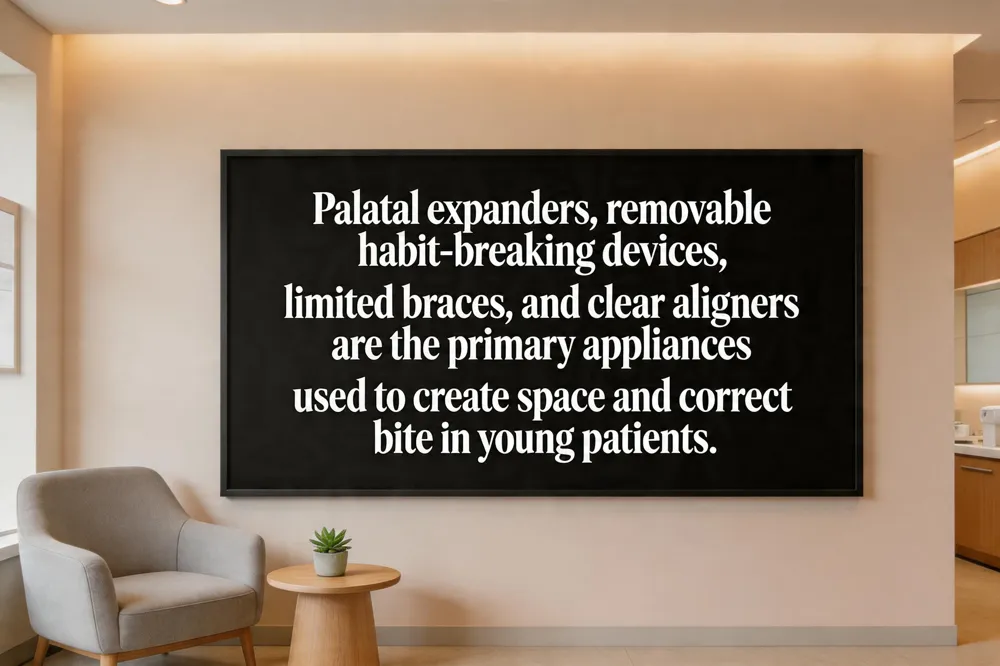
Early interceptive orthodontics relies on a limited set of age‑appropriate appliances.
Palatal expanders and rapid maxillary expansion – These devices split the mid‑palatal suture while it is still flexible (typically ages 6‑12). By gently widening the upper jaw, they create space, correct crossbites, improve breathing and reduce future crowding. The expander is worn 4‑6 months, causing only mild pressure.
Removable habit‑breaking devices – Custom acrylic plates or thumb‑sucking appliances discourage detrimental habits that can distort jaw growth. They are easy to insert and remove, allowing the child to maintain oral hygiene while the habit is eliminated.
Limited braces and clear aligners for young patients – Partial‑coverage brackets or short‑term clear trays target a few erupting teeth, guiding them into proper positions without full‑arch appliances. This approach shortens treatment time and is more comfortable for early patients.
Q: Does my 8‑year‑old really need an expander?
A: An expander is often the best option for children ages 6‑12 whose upper jaw is still developing, and an 8‑year‑old falls right in that sweet spot. Look for signs such as crowded or overlapping teeth, a crossbite, chronic mouth‑breathing, difficulty chewing or speaking, unusually early or late loss of baby teeth, or any jaw asymmetry—each can indicate a narrow palate that an expander can safely widen. By creating space early, an expander helps prevent more invasive orthodontic work later and promotes a healthier bite and smile. The device is typically worn for 4‑6 months and may cause mild pressure for a few days, but it is not painful. Schedule a quick evaluation with an orthodontist at Gentle Dentistry of Staten Island to determine whether an expander is right for your child.
Q: Early palatal expansion
A: Early palatal expansion is a preventive orthodontic procedure performed while the child’s mid‑palatal suture is still flexible, usually before the teenage growth spurt. By using a small, custom‑made expander to gently separate the two halves of the upper jaw, new bone fills the gap and creates a wider, more stable palate. This early intervention reduces crowding, prevents impaction of permanent teeth, and often eliminates the need for extractions or more invasive surgery later on. It also improves oral hygiene, breathing, and overall bite function, setting the stage for smoother, less extensive orthodontic treatment in the future. At Gentle Dentistry of Staten Island, we evaluate each child’s development to determine the optimal timing and customize the expansion plan for a healthy, confident smile.
Q: Early age orthodontic treatment
A: Early age orthodontic treatment, also called interceptive or preventive orthodontics, begins while some baby teeth are still present—typically around age 7—so the orthodontist can evaluate jaw growth and tooth eruption. By identifying problems such as underbites, crossbites, severe crowding, or habit‑related issues early, simple appliances (like palatal expanders or removable devices) can guide development and create space for permanent teeth, often reducing the need for more extensive treatment later. The first visit usually involves a thorough examination and monitoring plan; many children require no immediate intervention, while others may benefit from short‑term therapy followed by a later comprehensive phase. Early treatment can improve long‑term oral health, simplify future orthodontic work, and prevent more costly, complicated procedures during puberty. At Gentle Dentistry of Staten Island, Dr. Sterling and Dr. Skurnick use gentle, personalized approaches and modern technology to ensure each child’s smile develops healthily from the start.
Q: Interceptive orthodontic treatment examples
A: Interceptive orthodontic treatment often begins with a space maintainer, which holds the opening left by a prematurely lost baby tooth to guide the permanent tooth’s eruption. A common growth‑modification appliance is a palatal expander, which widens a narrow upper jaw to create space and improve bite alignment. Partial or limited‑coverage braces may be placed on only a few teeth to correct crowding or guide erupting incisors without full‑arch treatment. Functional appliances such as a Twin Block or Herbst device can redirect jaw growth in children with an underbite or overbite. Finally, habit‑intervention devices—like a thumb‑sucking appliance—help eliminate oral habits that can cause malocclusion.

Orthodontic loans make early treatment affordable by spreading costs over monthly payments. At Gentle Dentistry of Staten Island patients can use CareCredit, offering zero‑interest periods, or in‑house plans with modest down payments and no interest. Third‑party lenders such as LendingClub provide 12‑ to 24‑month options with variable rates, and combining plans gives flexibility to start right away.
A free Early Orthodontic Treatment PDF explains interceptive therapy during mixed dentition, highlighting rapid maxillary expansion, Twin‑Block, FR‑2, and pendulum devices. The documents detail indications, timing, and long‑term stability, showing how early guidance reduces extractions, improves self‑image, and simplifies later care—exactly the protocols Dr. Sterling and Dr. Skurnick follow.
Comprehensive orthodontic treatment addresses the entire bite with braces or clear aligners, typically lasting 12‑24 months. It begins with a thorough evaluation, regular adjustments, and ends with retainers. Gentle Dentistry of Staten Island tailors each plan, coordinating with specialists when needed to ensure comfortable outcomes.

Do orthodontists treat TMJ disorders? Yes. When a TMJ problem is linked to a misaligned bite or malocclusion, orthodontists can relieve pain, clicking, and headaches by correcting jaw relationships with braces, clear aligners, or bite‑adjusting appliances. If the issue stems from arthritis, trauma, or muscle dysfunction, the orthodontist coordinates care with dentists, oral surgeons, or physical therapists to ensure comprehensive treatment.
Limited orthodontic treatment focuses on minor, localized problems—such as a few crowded or rotated front teeth—rather than full‑arch correction. Using traditional braces, clear aligners, or partial appliances, results can be achieved in three to nine months, offering an affordable, less invasive option that can be combined with cosmetic procedures.
Preventive orthodontic treatment emphasizes early detection, typically by age 7, to guide jaw growth, create space for permanent teeth, and break harmful habits like thumb‑sucking. Space maintainers and habit‑breaking appliances reduce the need for extensive braces or surgery later, shortening overall treatment time and improving oral health.
Early orthodontic evaluation offers nine key benefits: catch bite problems early; guide jaw growth; use palatal expanders while the suture is flexible; maintain space or extract selectively; correct harmful habits; reduce trauma risk; shorten later treatment and lower cost; improve function (chewing, speech, breathing); boost self‑esteem.
Gentle Dentistry of Staten Island builds on these advantages with a low‑stress approach—digital imaging, clear communication, and customized plans respectful of each child’s comfort.
Families can start by calling for a free, no‑obligation screening, scheduling the first visit before age 7, and discussing concerns with Dr. Sterling or Dr. Skurnick. Follow‑up visits will monitor growth and adjust the plan as needed.
The practice’s caring team ensures each visit feels safe.